A Middle East Phenomenon: ... "Where Did All The Christians and Jews Go?"
Showing posts with label Egypt. Show all posts
Showing posts with label Egypt. Show all posts
Friday, January 6, 2012

Thursday, January 5, 2012
Sharia: Women's Rights and Rapes
YouTube:
Uploaded by YouCruising on Jan 5, 2012
In sharia compliant islamic countries sexual assault is a way of controlling muslim women.
Tuesday, January 3, 2012
Liberal Minded Muslim Brotherhood Movie Critic: “We Can Produce A Movie With Unveiled Actresses When Necessary”
Egypt Islamist leader, liberal director argue over future of cinema
 |
Al Arabia
The sweeping victory of Islamists in the first two rounds of Egypt’s first parliamentary elections after the ouster of former president Hosni Mubarak’s regime raised liberals’ concerns over a variety of issues, on top of which was the future of the film industry under a conservative government.
The debate between a prominent Muslim Brotherhood leader and a prominent liberal director served to give an insight into the aspects of the problem.
Head of the Muslim Brotherhood’s Film and Drama Committee Mohamed al-Naggar started with objections to the labels liberals sometimes give to types of films to distinguish between what is conservative and what is not.
“There is nothing called a Brotherhood film or a leftist film or a Nasserist film,” Naggar told Al Arabiya’s Parliament Race.
The sweeping victory of Islamists in the first two rounds of Egypt’s first parliamentary elections after the ouster of former president Hosni Mubarak’s regime raised liberals’ concerns over a variety of issues, on top of which was the future of the film industry under a conservative government.
The debate between a prominent Muslim Brotherhood leader and a prominent liberal director served to give an insight into the aspects of the problem.
Head of the Muslim Brotherhood’s Film and Drama Committee Mohamed al-Naggar started with objections to the labels liberals sometimes give to types of films to distinguish between what is conservative and what is not.
“There is nothing called a Brotherhood film or a leftist film or a Nasserist film,” Naggar told Al Arabiya’s Parliament Race.
Naggar explained that unlike what many people think the Muslim Brotherhood are not against cinema and do not believe that it is against Islam.
“On the contrary, cinema like any art is an integral part of human nature.”
What the Brotherhood cares about the most, he pointed out, is the production of movies that represent the values of society.
“We cannot reduce a movie into a couple of sex scenes because this does not reflect the reality of women in Egypt.”
When asked if the Brotherhood is willing to deal with unveiled actresses if it is to produce movies, Naggar replied in the affirmative.
“We can produce a movie with unveiled actresses when necessary.”
On the other hand, director Khaled Youssef stressed that filmmaking is an art with rules and technicalities and that unless those are employed properly, the outcome will not be real cinematic art.
Youssef objected to the focus placed by the Muslim Brotherhood and Islamists in general on sex scenes in Egyptian movies.
“Egyptian cinema is not a bunch of sex scenes. It is an art with a long history and great productions,” he told Parliament Race in the same episode dedicated to the future of cinema in Egypt following Islamists’ electoral victory.
As for the importance of having movies reflect Egyptian reality, Youssef said it will also be unrealistic to give preference to veiled actresses.
“This will neither reflect reality nor convince the audience.”
Youssef added that the history of Egyptian cinema is much deeper than that of the Muslim Brotherhood.
“Art was and still is one of the most important components of the Egyptian personality.”
Youssef stressed the important of including in the new constitution an article that grants freedom of creativity as long as social traditions are not compromised.
Regarding the possibility of some form of agreement between the Muslim Brotherhood and Egyptian filmmakers, Youssef found this unlikely.
“The art of cinema is about vision and there is a big gap in vision between the two parties.”
“On the contrary, cinema like any art is an integral part of human nature.”
What the Brotherhood cares about the most, he pointed out, is the production of movies that represent the values of society.
“We cannot reduce a movie into a couple of sex scenes because this does not reflect the reality of women in Egypt.”
When asked if the Brotherhood is willing to deal with unveiled actresses if it is to produce movies, Naggar replied in the affirmative.
“We can produce a movie with unveiled actresses when necessary.”
On the other hand, director Khaled Youssef stressed that filmmaking is an art with rules and technicalities and that unless those are employed properly, the outcome will not be real cinematic art.
Youssef objected to the focus placed by the Muslim Brotherhood and Islamists in general on sex scenes in Egyptian movies.
“Egyptian cinema is not a bunch of sex scenes. It is an art with a long history and great productions,” he told Parliament Race in the same episode dedicated to the future of cinema in Egypt following Islamists’ electoral victory.
As for the importance of having movies reflect Egyptian reality, Youssef said it will also be unrealistic to give preference to veiled actresses.
“This will neither reflect reality nor convince the audience.”
Youssef added that the history of Egyptian cinema is much deeper than that of the Muslim Brotherhood.
“Art was and still is one of the most important components of the Egyptian personality.”
Youssef stressed the important of including in the new constitution an article that grants freedom of creativity as long as social traditions are not compromised.
Regarding the possibility of some form of agreement between the Muslim Brotherhood and Egyptian filmmakers, Youssef found this unlikely.
“The art of cinema is about vision and there is a big gap in vision between the two parties.”
Saturday, December 31, 2011
Fair Is Fair: You Post 1 Cartoon Of Mohammed on Facebook and We Burn Your House (and All Of Your Neighbour's Houses Too)
Drawing of Prophet Muhammad leads to Coptic homes burned Egypt

The homes of Coptic Christians in southern Egypt have been burned in a display of enraged violence by outraged Muslims. Violence broke out following a drawing of the Prophet Muhammad being posted online by a Christian student.
Sectarian violence erupted in the Egyptian province of Assiut after a Christian student posted a drawing of the Prophet Muhammad on his Facebook page. According to the Washington Post the drawing depicted the prophet with four women seeking his hand in marriage.
Naharnet reported that police arrested the Christian student responsible for posting the drawing on Thursday, after dozens of Muslims stormed his house. His arrest did not appease the Muslims that were riled to violence by the image. They proceeded to set fire to a shop belonging to the student's father before turning their attention to burning seven houses belonging to Coptic Christians. Five members of the police were injured in the ensuing violence.
Ironically, when Muslims react violently to images of the prophet it results in further dissemination of such images. Any images of the prophet are considered blasphemous within Islam and this latest depiction resulted in the inevitable violence which has ensued on previous occasions when images and cartoons of the prophet have been circulated.
Policymic explains that the reason why images of Prophet Muhammad are forbidden in Islam is they "could lead Muslims to worship the man instead of the Creator."
Whilst those who practice Islam may find the images offensive, the circulation of such images by others is perceived as a cornerstone of free speech. There is no necessity for the scenes of such intolerant violence, yet they have become as inevitable as the fatwas which generally follow.
This latest outburst of sectarian violence further destabilizes relations between Coptic's and Muslims in Egypt. Already prepared to expect violence against the Copts during the Coptic Christmas and New Year, the army had promised extra security precautions around Coptic churches on Jan. 7.
Naharnet reported that police arrested the Christian student responsible for posting the drawing on Thursday, after dozens of Muslims stormed his house. His arrest did not appease the Muslims that were riled to violence by the image. They proceeded to set fire to a shop belonging to the student's father before turning their attention to burning seven houses belonging to Coptic Christians. Five members of the police were injured in the ensuing violence.
Ironically, when Muslims react violently to images of the prophet it results in further dissemination of such images. Any images of the prophet are considered blasphemous within Islam and this latest depiction resulted in the inevitable violence which has ensued on previous occasions when images and cartoons of the prophet have been circulated.
Policymic explains that the reason why images of Prophet Muhammad are forbidden in Islam is they "could lead Muslims to worship the man instead of the Creator."
Whilst those who practice Islam may find the images offensive, the circulation of such images by others is perceived as a cornerstone of free speech. There is no necessity for the scenes of such intolerant violence, yet they have become as inevitable as the fatwas which generally follow.
This latest outburst of sectarian violence further destabilizes relations between Coptic's and Muslims in Egypt. Already prepared to expect violence against the Copts during the Coptic Christmas and New Year, the army had promised extra security precautions around Coptic churches on Jan. 7.
Tuesday, December 27, 2011
Wednesday, December 21, 2011
EGYPT’S KRISTALLNACHT
Powerline

While tonight you commemorate a Jewish pogrom, I told them, Christianity has just suffered its own “Kristallnacht” … and I have yet to see much of a Christian response.
The persecution of Christians in Egypt is one of the mysteriously underreported stories of our time. At Big Peace, Charles Jacobs writes:
Gordon College is a Christian school between Salem and Rockport. A few weeks ago I spoke there at a commemoration of Kristallnacht, Germany’s night of broken glass, the first mass assault on Europe’s Jews and the harbinger of the Shoah. I told the Christian audience how good it was to feel Christian support for Jews in these times, and that even some of the most stubborn of my people were now appreciating Evangelical support for Israel. I also said that we felt this blessed support came from a spirit of Christian altruism. But given the news from the Middle East, concern for others is surely not the only reason Christians need to support Israel.

I asked how many in the audience of 250 knew of Anne Frank. Almost every hand shot up. Then I asked how many had heard of Ayman Labib. I got a mass blank stare. Ayman was a 17-year-old Egyptian Christian who just weeks ago was beaten to death by his Muslim classmates as teachers watched because he refused their demand to remove his cross necklace.
I asked how many knew about the Maspero massacre, which had left at least 24 Copts dead and 270 injured. And whether they knew that since January, there had been more than 70 attacks on Christian churches or institutions in Egypt.

While tonight you commemorate a Jewish pogrom, I told them, Christianity has just suffered its own “Kristallnacht” … and I have yet to see much of a Christian response.
In this video, Cynthia Farahat, a Christian Egyptian, testifies before the Tom Lantos Human Rights Commission. Among other things, she describes the fate of her friend Michael Mosad:
His legs were nearly severed from his body. As [Michael’s fiancée] sat next to him …soldiers gathered … brutally beating and kicking his motionless body. Vivian threw her body over his to protect him … but military officers beat and cursed her; they called her an infidel, ‘Christian sons of dogs,’ and worse–

The plight of Christians in Egypt and across the Muslim Middle East has become critical, but, for reasons I cannot understand, almost all American Christians seem indifferent to the fate of their fellow Christians overseas.
Monday, December 19, 2011
Sunday, December 18, 2011
Over 1400 Years Of Back To The Future
From YouTube: Uploaded by securefreedom on Dec 7, 2011
Raymond Ibrahim (Middle East specialist and Associate fellow, Middle East Forum) testifies before the Tom Lantos Human Rights Commission in the House of Representatives. Reps. Frank Wolf and James McDermott presented "Under Threat: The Worsening Plight of Egypt's Coptic Christians." Other witnesses included Kathy Fitzpatrick (Deputy Assistant Secretary, Bureau of Democracy, Human Rights, and Labor, U.S. Department of State); Nina Shea (Director, Center for Religious Freedom, Hudson Institute); Dina Guirguis (Member, Egyptian American Rule of Law Association); Adel Guindy (President, Coptic Solidarity International); and Cynthia Farahat (Egyptian political activist).
Wednesday, November 30, 2011
Virginity Test Required For Female Attendees At Tahrir Square Demonstration

Samira Ibrahim is speaking out against mistreatment she said she was subjected to by the Egyptian Army. The Tahrir Square protester said she was detained back in March, beaten and abused, including being subject to a "virginity test."
Samira Ibrahim, 25, made a seven-hour train ride to Cairo Monday night, to hear the verdict in her case against the Egyptian army.
She sued the army and accuses the miliaty of subjecting her to torture and abuse, including a so-called “virginity test,” while in military detention back in March. Judges had promised to issue a verdict on Tuesday.
Standing on the front steps of a Cairo courthouse, her round face wrapped tightly in a fuchsia headscarf, Ibrahim admitted she was nervous. But there was something that gave her confidence. About a dozen Egyptian friends, activists and lawyers came to court to support her.
A young, bearded Egyptian engineer named Hossam al-Din introduced himself as a Salafi, an ultra-conservative branch of Islam. Al-Din said he met Samira Ibrahim in early February in Tahrir Square. He has gotten to know her since then and he’s here because what happened to Ibrahim could happen to any Egyptian girl – Christian or Muslim, he said – under this military government. That's not acceptable.
Tuesday in court was a big disappointment. The judge did not make a ruling. Instead the case was postponed until late December. After the announcement, Ibrahim was visibly frustrated.
“I’m not angry,” Ibrahim says. “They’re just stalling, trying to kill my case. But I’m not going to give up.”
Ibrahim has described what happened to her – in detail – in a video posted online:
Ibrahim, along with 16 other women, were detained during a demonstration on March 9. She was held for four days and during that time, she said, soldiers beat her repeatedly. They subjected her to electric shocks, screamed at her and threatened her. Then, worst of all, they made her strip so a man in a military uniform could check to see if she was a virgin.
She felt like she had been raped.
In June, Ibrahim filed a criminal complaint against the army, but the case has gone nowhere. So she filed suit in civil court, with the help of several human rights groups. They are asking judges to rule on the legality of Ibrahim’s treatment by the military. If they win the case, it could amount to a serious legal blow to Egypt’s military rulers.
Ahmed Hossam, Ibrahim’s lawyer, stood outside the courtroom smoking one cigarette after another. He said this case was incredibly sensitive politically. Hossam is not sure how the judges will rule.
Observers say it is hard to overstate just how much courage it takes for Ibrahim to go through with her case. Ibrahim isn't the only woman who has been subjected to “virginity tests” while in military detention, but sexual abuse carries a powerful stigma, said Heba Morayef of Human Rights Watch.
“Egypt remains a very conservative society and even talking about the fact that these virginity tests took place is very difficult for young women," Morayef said. "In fact, most of the women who’ve been subjected to these forced virginity tests have not wanted to come forward.”
Ibrahim’s lawyer said the case is probably being held up because the political atmosphere is so sensitive right now, with the recent violence and ongoing parliamentary elections.
“There’s not much to do now,” he said. “Except to wait.”
As for Ibrahim, she won't wait for anything. Minutes after the disappointing announcement in the courtroom, she joined a small group of demonstrators and together, they marched straight back to Tahrir Square.
Monday, November 28, 2011
Saturday, November 26, 2011
Shift in tone at White House over Egypt
Who are the good guys and who are the bad guys in Egypt? Until recently, the Obama administration has gone out of its way to praise the Egyptian military for its stabilizing influence and its apparent progress in moving toward a national election. CNN reports that the White House has had a “major shift” in tone regarding the generals:
Gee, who was it that said that quick elections in Egypt would be a disaster? Unfortunately, by pushing to have Hosni Mubarak resign just eight days into the Tahrir Square protests, Barack Obama boxed Egypt into a corner. Either hold quick elections that only the Muslim Brotherhood would be organized enough to exploit, or have the military keep power for an extended period of time and continue to stir up unrest in Egypt. The notion that “the street” should determine Egypt’s course is even more fraught with peril, as Ynet News reported today (via JWF):
A Muslim Brotherhood rally in Cairo’s most prominent mosque Friday turned into a venomous anti-Israel protest, with attendants vowing to “one day kill all Jews.”Some 5,000 people joined the rally, called to promote the “battle against Jerusalem’s Judaization.” The event coincided with the anniversary of the United Nations’ partition plan in 1947, which called for the establishment of a Jewish state.However, most worshippers who prayed at the mosque Friday quickly left it before the Muslim Brotherhood’s rally got underway. A group spokesman urged attendants to remain for the protest, asking them not to create a bad impression for the media by leaving.Speakers at the event delivered impassioned, hateful speeches against Israel, slamming the “Zionist occupiers” and the “treacherous Jews.” Upon leaving the rally, worshippers were given small flags, with Egypt’s flag on one side and the Palestinian flag on the other, as well as maps of Jerusalem’s Old City detailing where “Zionists are aiming to change Jerusalem’s Muslim character.”…Muslim Brotherhood spokesmen, as well as Palestinian guest speakers, made explicit calls for Jihad and for liberating the whole of Palestine. Time and again, a Koran quote vowing that “one day we shall kill all the Jews” was uttered at the site. Meanwhile, businessmen in the crowd were urged to invest funds in Jerusalem in order to prevent the acquisition of land and homes by Jews.
Yeah, that’s a great outcome for the US — trading Mubarak for a short-lived democracy that will catapult the Muslim Brotherhood into power and touch off a new war with Israel. Good luck moving through the Suez Canal next year!
The generals in Egypt have decided to keep power for a little while longer with former Mubarak figures, but not because they didn’t try to get some reformers to work with them:
Egypt’s embattled military rulers appointed a new prime minister Friday as fiery crowds of supporters and opponents took to the streets, exposing the severity of a split over the leading role of the nation’s long-revered armed forces on the eve of parliamentary elections.As the largest crowd of the week-long protests gathered in central Cairo’s Tahrir Square to demand that Egypt’s military chiefs step aside, thousands of angry Egyptians demonstrated near downtown in support of the generals and “stability.” A small pro-military group also turned out in the port city of Alexandria, where pitched clashes between anti-military council protesters and security forces continued. …Meanwhile, tens of thousands of protesters poured into Tahrir Square, the birthplace of what most are calling Egypt’s unfinished revolution. They rejected the appointment of Kamal el-Ganzouri, 78, who had served as prime minister during Hosni Mubarak’s presidency. He was asked to form a new cabinet to replace the caretaker government that resigned this week amid deadly clashes between security forces and rock-throwing demonstrators.The military chiefs chose Ganzouri after holding intensive discussions with more prominent figures such as Amr Moussa, the former Arab League chief, and Mohamed ElBaradei, a Nobel Peace Prize laureate who formerly headed the International Atomic Energy Agency. Both turned down the job after demanding broad powers, according to political figures briefed on the meetings.In Washington, the White House called Friday for the new government to be “empowered with real authority immediately” and for elections to go ahead “expeditiously,” leading to a full transfer of power to a civilian government. The U.S. administration has been hesitant to fully support protesters against the Egyptian military, an institution that receives billions of dollars in U.S. aid.
Is military rule a preferable outcome? Not at all. However, we should have tried to work through Mubarak first rather than rush to throw him aside. Meanwhile, the State Department insisted for months of brutal repression in Syria that Bashar Assad was a “reformer” with whom we could work despite his alliance with Iran, while we castigated and abandoned one of the rare Arab leaders willing to keep peace with Israel. Whatever that was, it certainly wasn’t “smart power,” and this outcome was predictable.
Thursday, November 24, 2011
Time Tested Interrogation Technique ... Sexual Assault

Mona Eltahawy is a US-based Egyptian journalist. Photograph: Observer
Journalist Mona Eltahawy alleges sexual assault in Egypt detention
The Guardian
The US-based Egyptian journalist Mona Eltahawy has been released, according to her personal Twitter account, after 12 hours in detention at the hands of Cairo security forces. A later tweet from the account @monaeltahawy said that she was sexually and physically assaulted while being held inside the interior ministry in Cairo, in the early hours of Thursday morning.
A US embassy representative in Cairo told the Guardian that the reports of her detention were "very concerning" and that "US embassy consulate officers are engaging Egyptian authorities".
At 10:30am on Thursday, the former Reuters Middle East correspondent who has been lauded for her recent coverage of the Egyptian uprising, began tweeting that she had spent 12 hours in detention under the authority of interior ministry and military intelligence officials and that she had suffered a serious sexual assault by up to half a dozen members of the Egyptian security forces. She also said that she had been kept blindfolded for hours and also posted a picture of her severely bruised hand and then both her arms in casts.
She also thanked supporters after #freemona began trending around the world on Twitter.
In a series of tweets on Wednesday night, Eltahaway who is a columnist for various papers including the Toronto Star, the Jerusalem Report and Denmark's Politiken, and has also written for the Guardian, described scenes in and around Tahrir Square including news that a family friend of hers had been killed. She ended the message by damning the Supreme Council of the Armed Forces (Scaf) who have control overEgypt's transition.
At approximately 11pm GMT she wrote "Pitch black, only flashing ambulance lights and air thick with gas Mohamed Mahmoud #Tahrir". At around the same time she then described the violence occurring around the gates of the American University in Cairo of which she is an alumnus.
"Across street from AUC gate I used to enter every day Mohamed Mansour. Can't believe it. A cacophony sirens, horns, flashing ambulance lights" In a penultimate tweet she appeared to write "Beaten arrested in interior ministry".
Other journalists are also thought to have been detained on Wednesday night. Eltahawy last wrote for the Guardian on Friday about a young Egyptian female blogger who had decided to post a naked photo of herself on her blog in an act of defiance.
The 44-year-old was born in Port Said, but later lived in the UK, Saudi Arabia and Israel, settling in the US in 2000.
In 2009, the European Union awarded her its Samir Kassir prize for Freedom of the Press, and last year she was awarded the Anna Lindh Foundation's special prize for Outstanding Contribution to Journalism.
The Egyptian embassy in London has yet to comment on her detention.
Wednesday, November 23, 2011
Another Day in the Park ... I Think It Was Al-Qaeda
People Threatening, People Screaming ... A Man Selling Qurans
Naughty Muslim Music Video
Globaile
Sandy, as she usually goes by, is the new talented pop diva in the Arab music world hailing from Cairo, Egypt. She released her first album Kol Ma Arrab in 2006. Distributed by Star Label, the album included the single Kol Ma Arrab, and put Sandy on the map with her sultry voice and sexy beats.
Move over Cleopatra - there's a new queen in Egypt. And her name is Sandy Star.
Sandy, as she usually goes by, is the new talented pop diva in the Arab music world hailing from Cairo, Egypt. She released her first album Kol Ma Arrab in 2006. Distributed by Star Label, the album included the single Kol Ma Arrab, and put Sandy on the map with her sultry voice and sexy beats.
But it wasn't until 2009 that Sandy really blew up. She achieved her first bonafide hit with Shoftoh W Makalemneish. That single came off of the release of her second album Lessa Soghayarah on the extremely popular Arab label, Melody Music. She is currently working on her new album Ad Eltahadythat will also be distributed by Melody Music.
Here is her video for the song Eyak off her latest album. We love the Arabic drums in this riddim, and her voice is so smooth and alluring...She's not too hard on the eyes either... ;)
Monday, November 21, 2011
Sunday, November 20, 2011
Israelis Strip in Support of Egypt Blogger
Dozens of women pose for nearly nude group shot in show of solidarity for young activist who posted naked photo in protest of limited freedom of expression in her country
Dozens of Israeli women stripped off their clothes Saturday in a show of solidarity with the 20-year-old Egyptian blogger who caused a stir in the Arab world last week when she posted a naked photo of herself in protest against the limits on free expression in her country.
Touched by the spirited protest measure, some 40 Israelis posed for a nude group shot in support of the Egyptian activist,Aliaa Magda Elmahdy, who received threats and harsh criticism for her actions. Unlike Elmahdy, however, the Israeli women did not fully display their intimate parts for the camera.
The brains behind the operation is Or Tepler, 28, who opened a Facebook event inviting women "to show support in a non-violent and legitimate way for a woman who is just like us – young, ambitious, full of dreams and evidently has a developed sense of humor."
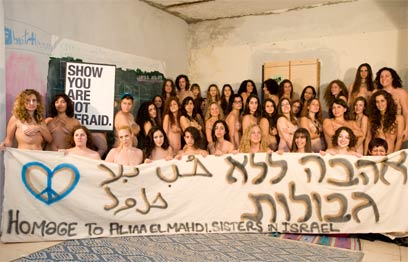
'Love without limits' (Photo: Anat Cohen)
"Girls, let's give the world a good reason to see the unique beauty of Israeli women," Tepler wrote. "Regardless of whether they are Jewish, Arab, straight or Lesbian – because here, as of now, it doesn't matter. (…) Let us show the doubters that our international discourse doesn't depend on governments."
'I won't deny being a leftist'
More than 100 women said they would attend. The participants were photographed holding a sign saying "Love without Limits," and "Homage to Aliaa Elmahdi. Sisters in Israel."
"I got the idea the day that the blogger's photo was posted," Tepler told Ynet. "I didn't expect that she would get the response that she got. It got on my nerves that she received a quarter of a million abusive comments and death threats. (…) I felt that when a liberal, enlightened woman in Cairo cannot express herself and gets threats from her state, I should show solidarity.
"Of course there's the nationalistic aspect, and I won't deny being a leftist and a seeker of peace," she added. "I feel like the governments don't represent the enlightened, simple people who want peace."
Tepler, who was active in the social protest movement over the summer, made efforts to get in touch with Elmahdy, but was unsuccessful.
"She's as popular as Daphni Leef on the 14th of July," she explained. "I sent her an e-mail, but I saw that her Twitter and Facebook account have been closed. People really want to take her down, while we want to show her that there are many groups that support her."
Saturday, November 19, 2011
Belly Dancing Is A Sin
Row over 3 new belly dance channels in Egypt
CAIRO - A group of unidentified businessmen has launched three international Arabic-language television channels as part of a project to promote Egyptian belly dancing in the region and abroad.

Each day lovers of Oriental dance enjoy watching this ancient Egyptian art el-Farah (Arabic for Joy), el-Teet and Darabuka (The Drum) channels on NileSat 1.
From Europe to Asia and North America, each day lovers of Oriental dance watch el-Farah (Arabic for Joy), el-Teet and Darabuka (the drum) channels on NileSat 1 to enjoy this ancient Egyptian art.
These three channels show professional and amateur dancers from around the world as well shoddy Egyptian singers, who take part in elaborate non-stop shows.
"If you haven't seen el-Farah or el-Teet or Darabuka, you have not seen real dancers or heard true Egyptian folk singers," said Aya Salah, a university student, who loves belly dancing.
However, Zainab Naguib said that she totally rejected the idea of launching these three channels, which she dismissed as immoral and vulgar.
"It is absolutely wrong and unnecessary to have these channels because they are offensive to our religion, honour and customs," Mrs Naguib told The Gazette yesterday, stating that the launching of el-Farah, el-Teet or Darabuka highlight the dangers posed by such offensive channels and that the three channels have nothing to do with personal freedom.
"If freedom harms others, it is no longer a freedom," she argued, adding that she considered belly dancers as sinful.
"These dancers are sinners because they wear outfits that do not cover the breasts, the belly button and what is below that. They also make gestures that awaken the sexual instincts of viewers," she explained.
Mrs Naguib, a veiled Government employee, added: "Freedoms and public rights are not absolute, they are limited by the respect of the family which is the base of the Egyptian conservative society that rejects any form of seduction."
Such entertainment forms are branded un-Islamic and are associated with prostitution, she asserted.
But, Fadi Habib, another young Government employee, disagrees with Mrs Naguib's views saying that he considered the three channels as a sort of relief from the daily grind in Egypt.
Habib said that he liked el-Farah and el-Teet because they had helped revive the pre-1952 Revolution golden age of Egyptian belly dance, embodied in the legendary Samia Gamal or Tahia Karioka, who kept the art in Egyptian hands.
For Lamia Amin, a secondary school student, these three channels were a good project to preserve Oriental dance, which she felt had not been given its rightful due. She pointed out that the new channels would broadcast entertainment programmes 24 hours a day to a potential audience of about 200 million young people in Arab countries.
"The three channels, which began work last month and can be received across the Middle East, North Africa, Asia and North America, will serve as an important bridge to preserving Oriental dance.
Clad in revealing costumes and heavily make-up, the gaudily bejewelled women do not stop dancing and singing, Lamia said, adding that it was better to watch el-Farah or el-Teet or Darabuka than watch the region's depressing and sad news.
She maintained that belly dancing had grown in popularity outside of the Arab world in recent years.
Friday, November 18, 2011
Egyptian Islamic Scholar Storms Concert to Condemn Music
Egyptian Salafist figure storms student concert, reignites debate over Music in Islam

Popular Egyptian Islamic Salafist scholar Hazem Shoman (right) storms into the Egyptian singer's Hisham Abbas' music concert to advise the audience that gender mixing and singing are both haram. (Al Arabiya)
Students at Nile Academy campus in the city of Mansoura were surprised when Shoman took the stage of Hisham Abbas’ concert “advising” them that music is “haram,” or forbidden in Islam, and that they should not be watching or listening to it.
The students reportedly responded with chants against the scholar, and in order to prevent the escalation of the situation, the academy’s vice president Mohamed Abdel Ghaffar and other officials interfered and persuaded Shoman to vacate the venue.
In a TV interview by Nile channel, Shoman later said that he was “shocked” to enter the concert hall and see female dancers mixing with men.
He said that he decided to give “advices” to the concert’s youth whom he described as responsive to his concerns. According to him, the concert was later canceled after the withdrawal of a “sizeable group of the attendees.”
Khalid Saeed, a spokesman for the Salafi Front, hailed Shoman’s “good behavior” but said Shoman only represented himself as an individual Salafi advocator.
But Saeed told the electronic al-Ahram newspaper that the concert is “unacceptable” and that it was “full of sins” with both genders mixing.
Prominent Islamic figure Salim al-Awa, likewise, said Shoman’s behavior was his own and did not represent any religious or political bloc in the country and that whether singing is forbidden in Islam was still an unresolved issue among the clerics and scholars.
Awa said that there was no evidence in the Quran or in the teaching of the prophet that singing is “haram,” but he said there was “evidence” that anything that leads to committing sins should be banned.
Subscribe to:
Posts (Atom)