Showing posts with label Prostitution. Show all posts

Wednesday, January 4, 2012

Maldives Reverses Closures of "Prostitution' Spas ... It Was The Opposition Party's Idea!


The Maldives has overturned a decision made last week to shut down all spas and health centres in resorts, President Mohamed Nasheed has declared.
The ban followed allegations by an opposition Islamist party that spas were being used for prostitution.
President Nasheed said that he has asked the Supreme Court to decide whether operating spas is against the principles of Islam.
The ruling could be critical to the Maldives' tourist economy.
The islands are a popular destination for wealthy honeymooners and celebrities where luxury rooms can cost up to $12,000 (£7,700) a day.
"We have lifted the ban and all the services will be available for tourists," President Nasheed told Reuters news agency. "We wanted to give confidence to tourists."
The president said that he had ordered the ban in response to calls by the main opposition party, which claimed the spas were fronts for prostitution and led to the spread of drugs and alcohol to locals in the mainly Sunni Muslim nation.

Thursday, December 29, 2011

Maldivians Defend Islam by Closing All Spas


Tourism Ministry issues circular to close spas and massage parlors
After thousands of protesters gathered last Friday and demanded the government “close the spas and massage parlors and such places where prostitution is conducted”, the Tourism Ministry has today published a circular asking all the resorts to shut down their spas and massage parlors.
Press Secretary for the President Mohamed Zuhair today confirmed to Minivan News that the Tourism Ministry had issued the circular.
The circular informs that the government has decided to shut down all the spas and massage parlors in accordance with demands made by the general public during last Friday’s protest to “defend Islam.”
Speaking at a press conference held yesterday, Zuhair said the protesters did not specify where exactly the prostitution was conducted but mentioned that prostitution was conducted inside spas and massage parlors.
He said the government does not know how to differentiate between the spas and massage parlors that are complicit with prostitution and those which are not.
Therefore, Zuhair said the government has decided to shut down all such locales because Maldivians, including high-profile individuals, have been visiting tourist resorts and having spa treatments.

Tuesday, November 22, 2011

Chasing the Dragon in Tehran


Behind its façade of Muslim piety, Iran is one of the most drug-addled countries in the world.

Today's Islamic Republic offers premonitions of a narcodystopia. Take a car ride through Tehran at night, and your driver may tell you that the underage girls in chadors who offer esfand -- seeds that are burned to ward off the evil eye -- along the highways are really selling sex to enable addicted fathers. Ride the metro, and you will see battered children pitching trinkets and fortunes to sustain their parents' habits.

BY ROLAND ELLIOTT BROWN, Foreign Policy
TEHRAN – On June 26, Iranian state media reported that 20,000 former drug addicts had assembled at Tehran's Azadi Stadium to mark the International Day against Drug Abuse and Illicit Trafficking. President Mahmoud Ahmadinejad attended, and used the podium to portray narcotics as an implement of Western predation. "Today," he said, Western countries "have begun harming nations, especially the Iranian nation, by drugs. Arrogant states masquerade themselves behind the so-called humanitarian masks and they want to stir a sense of inability in other nations. They put on masks of freedom-seeking, human rights, and protecting people but in fact they are the biggest criminals in the world." 
Tehran is one the higher capitals on the earth's surface, and not only in terms of altitude. The United Nations Office on Drugs and Crime (UNODC) reports that Iran has 1.2 million "drug-dependent users," and that 2.26 percent of the population aged 15-64 is addicted to opiates. The organization's director, Yuri Fedotov, has praised Iran for having "the world's highest rate of seizures of opium and heroin," and for developing effective treatment and prevention programs. Human Rights Watch, by contrast, has criticized Fedotov for glossing over the country's inadequate legal proceedings and executions of drug offenders. Most alarmingly, people arrested during opposition demonstrations, such as the Dutch-Iranian Sahra Bahrami, have occasionally been hanged as "drug smugglers."
Today's Islamic Republic offers premonitions of a narcodystopia. Take a car ride through Tehran at night, and your driver may tell you that the underage girls in chadors who offer esfand -- seeds that are burned to ward off the evil eye -- along the highways are really selling sex to enable addicted fathers. Ride the metro, and you will see battered children pitching trinkets and fortunes to sustain their parents' habits. Visit a poor southern suburb like Shahr-e Rey, and you might see a cigarette vendor in the bazaar with a sideline in used needles. Walk through Khaju Kermani Park on the capital's southeastern outskirts, and you might witness young girls smoking crystal meth in full view of park authorities, while in the background a tall, badly sunburned man with track marks on his arms staggers around in an ill-fitting, woman's blouse.
Yet the Iranian drug scene is not an exclusive feature of the country's decadent capital, or solely of its abject underclass. Its roots run deep and wide: For example, when I was visiting the tomb of the 12th-century poet Saadi, a tourist attraction in the southern city of Shiraz, Azad, a local literary critic who was showing me around, gestured beyond the garden walls to the adjacent neighborhood, named Saadieh after the poet. This he identified as a hub for the region's thieves, traffickers, and drug addicts. "Would you like to visit? It's very easy to visit, but you might not come back alive," he joked. I had seen enough Iranian skid rows to demur, but, intrigued by the apparent intersection of drugs and high culture, I pressed him for insights.
In a display of Persian hospitality, he invited me to the home of a learned opium enthusiast to witness a display. Opium, Azad told me, is Iran's oldest and most entrenched drug, and was used medically in the region by Avicenna, the great Persian philosopher-scientist, 1,000 years ago. In ensuing centuries, it was extolled by the poets of the Persian canon. The best-loved of these, Hafez, measured his ecstasies against it, writing, in the genre of love:
"A wound from you is worthier than salve from others/Your poison, sweeter than the opium they render."
When we entered the front room of a large house on the city's periphery -- shielded from the street by high walls -- there lay arranged on the floor a metal brazier full of coals, an opium pipe, and other paraphernalia, along with plates of watermelon (your reliable narrator partook only of the fruit).
"We love it and we hate it," remarked Mani, Azad's friend, a soft-spoken and serious academic in his sixties, as he began to light up. "It has so many problems, difficulties, but also attractions. In my family, my father used it, but he would always say, ‘Don't touch it.' He was against it because he used it himself, but later we smoked it together. I used it because it seemed romantic, poetic."
"When you first use it," Azad added, "it makes you relaxed. It makes you have good sleep, or it can give you nightmares and make your imagination work. Especially when you do [creative] work, it gives you the concentration you need. Mowlana, the poet, used it 800 years ago and mentioned it in his work. Hafez mentioned it. But in Iran today, artists and writers have no role, and they are suffering from their own nothingness, so they become disappointed, and look for something to make them calm."
"Socially it's looked at very negatively," Mani added slowly as he recovered from a long hit. "It's often criticized in government propaganda. And there's the impact it has on families. But it is still accepted in some parts of Iran, like in [the south-eastern province of] Kerman. Traditionally, when a girl gets married there, among the things she's expected to take to her husband is an elaborate set for preparing opium, even though it's illegal."
"In the shah's time," he continued, "there was even a certain prestige attached to it. His brothers used it. His father was an opium addict, and everyone knew it. In Islam, the attitude towards opium is not completely negative; in fact, it's not mentioned." Before the revolution, he added, "there was a brand of opium known as 'senator.' Now, they should call it 'ayatollah.'"
Despite his insinuation of the drug's appeal to Iran's rulers past and present, Mani sees opium as a drug in decline. "There is a lot of pressure from outside, because most of the heroin and opium that gets into Europe goes through Iran. [The international community] gives the government money to respond," he said, referring to financial support Western countries give UNODC. The result, he said, is that opium has become expensive. "Mostly rich people use it now, but the quality is much worse. It might be quite dangerous. Chemical drugs are much cheaper and more accessible to the youth, and they require less paraphernalia."
Before I left, Azad asked me to be careful with the pictures I had taken of their session because "the government is after just such a thing, especially when it involves intellectual people."
Back in Tehran, I sought a more clinical take on the subject, and met Ali, a gentle 32-year-old social worker at an addiction treatment facility in the city's eastern Tehranpars neighbourhood.
"The problem of drugs in Iran does not belong to any particular class or educational background," he emphasized. He sees more than 100 regular patients, from a range of economic spheres. Some are poor Afghan workers with no legal status or family support, while others are -- or have been -- wealthy. "One [of my patients] is a dentist who worked in the United States," he said, aiming to surprise.  "He had a car accident there, and was injected with morphine. After he was released from hospital, he started injecting himself, and eventually lost everything he had and moved back to Iran."
Ali described two main classes of drugs with which he deals. There are opiates, such as opium, morphine, and "crack" (which in Iran describes not the most addictive form of cocaine, but the most impure form of heroin) -- and synthetics, which includes ecstasy, psychedelics, and "shisha" -- crystal meth. Shisha and crack habits, Ali told me, are the most common forms of addiction.
More Here

Saturday, November 19, 2011

The Fate Of Muslim Prostitutes


Drifted and Forgotten
The flourishing of prostitution in Muslim countries is a paradox that we often overlook as a problem of our ummah. As prostitution is condemned and forbidden in Islam, and these women, to an extent, are marginalized and invisible in our community, many of us are not aware of the magnitude and realities of this problem. We do not consider them as a cause worth fighting for as we do for the betterment of the poor, abused, homeless, oppressed and ailing. To make matters worse, misinformation is widespread and the voices of former prostitution victims are systematically silenced.
Among the factors contributing to the widespread practice of prostitution among Muslim countries include:
  • The denial of the existence of such problems in our community
  • Spreading of the truth impedes men’s comfort and pleasure in using women
  • Hindrance of profitability of the industry, especially for those players who are politically connected
  • Prostitution is too horrible of a practice, a highly stigmatized taboo subject, that people would rather not hear details about
Majority of us may have the idea that prostitution is a choice and the women enjoy what they do. The reality is quite the contrary for many of them. On many occasions, deprivations, conflicts, and difficult circumstances often lead to desperation, and desperation forces these women into the practice of prostitution. Many are uneducated women who live in poverty and possess few marketable skills. My research finds that prostitutes are many times:
  • single mothers making ends meet for their children.
  • victims of incest and sexual abuse.
  • manipulated homeless teenagers.
  • displaced sufferers of human trafficking.
  • They are distraught girls with failed early marriages.
  • They are refugees who fled from their war-torn countries.
While we criminalize them for living in adultery, spreading diseases, disrupting family institutions, and giving birth to innocent, illegitimate children who suffer for having dishonorable mothers, we fail to see the other spectrum of the consequences of prostitution. The consequences are not only devastating to the society, but also to the prostitute herself as a person. It completely destroys her already shattered life, being reduced down to a depersonalized, sexual object.  She develops a personality where she is unable to develop trust in relationships and slowly numbs herself, to the point where she loses the ability to feign attachments to anyone or anything.  In order to survive this overwhelming, daily ordeal, she dissociates from her real self, originally as a defense mechanism; sadly, it reaches to the point of complete shut down, where she is stripped of her identity, and over time, she disappears.

In addition, where violence against women is considered, prostitution is usually exempted from this category. However, the health effects of prostitution are similar; injuries, infections, and psychological stress are suffered by women subjected to prostitution as well as other forms of violence against women. Apart from sexual violence, prostitutes experience physical violence by their pimps, brothel owners, and clients as a means to keep them under control. Homicide is a frequent cause of death for women in prostitution. They are vulnerable to sexually transmitted diseases, pelvic inflammatory disease, and cervical cancer, not to mention their risk of unwanted pregnancies, which often lead to a lack of prenatal care or unsafe abortions. Moreover, they may suffer from post-traumatic stress disorder, depression, anxiety, and, eventually, may resort to substance abuse as a coping mechanism. The vicious cycle then continues.

I believe that no woman in her right mind would want to be a sex slave.  In  prostitution, research involving nine countries revealed that when the prostitutes were asked, ‘What do you need?’, 89% responded that they desired to ‘leave prostitution’ (Farley, 2003). This was followed by ‘job training’, ‘home or safe place’, ‘health care’, ‘individual counseling’ and other supportive measures. 

Belly Dancing Is A Sin


Row over 3 new belly dance channels in Egypt 

CAIRO - A group of unidentified businessmen has launched three international Arabic-language television channels as part of a project to promote Egyptian belly dancing in the region and abroad.

Each day lovers of Oriental dance enjoy watching this ancient Egyptian art el-Farah (Arabic for Joy), el-Teet and Darabuka (The Drum) channels on NileSat 1.
   From Europe to Asia and North America, each day lovers of Oriental dance watch el-Farah (Arabic for Joy), el-Teet  and Darabuka (the drum) channels on NileSat 1 to enjoy this ancient Egyptian art.
   These three channels show professional and amateur dancers from around the world as well shoddy Egyptian singers, who take part in elaborate non-stop shows.
   "If you haven't seen el-Farah or el-Teet or Darabuka, you have not seen real dancers or heard true Egyptian folk singers," said Aya Salah, a university student, who loves belly dancing.
   However, Zainab Naguib said that she totally rejected the idea of launching these three channels, which she dismissed as immoral and vulgar.
   "It is absolutely wrong and unnecessary to have these channels because they are offensive to our religion, honour and customs," Mrs Naguib told The Gazette yesterday, stating that the launching of el-Farah, el-Teet or Darabuka highlight the dangers posed by such offensive channels and that the three channels have nothing to do with personal freedom.
   "If freedom harms others, it is no longer a freedom," she argued, adding that she considered belly dancers as sinful.
    "These dancers are sinners because they wear outfits that do not cover the breasts, the belly button and what is below that. They also make gestures that awaken the sexual instincts of viewers," she explained.
   Mrs Naguib, a veiled Government employee, added:  "Freedoms and public rights are not absolute, they are limited by the respect of the family which is the base of the Egyptian conservative society that rejects any form of seduction."
   Such entertainment forms are branded un-Islamic and are associated with prostitution, she asserted.
   But, Fadi Habib, another young Government employee, disagrees with Mrs Naguib's views saying that he considered the three channels as a sort of relief from the daily grind in Egypt.
   Habib said that he liked el-Farah and el-Teet because they had helped revive the pre-1952 Revolution golden age of Egyptian belly dance, embodied in the legendary Samia Gamal or Tahia Karioka, who kept the art in Egyptian hands.
   For Lamia Amin, a secondary school student, these three channels were a good project to preserve Oriental dance, which she felt had not been given its rightful due. She pointed out that the new channels would broadcast entertainment  programmes 24 hours a day to a potential audience of about 200 million young people in Arab countries. 
   "The three channels, which began work last month and can be received across the Middle East, North Africa, Asia and North America, will serve as an important bridge to preserving Oriental dance.
   Clad in revealing costumes and heavily make-up, the gaudily bejewelled women do not stop dancing and singing, Lamia said, adding that it was better to watch el-Farah or el-Teet or Darabuka than watch the region's depressing and sad news.
   She maintained that belly dancing had grown in popularity outside of the Arab world in recent years.


Friday, November 18, 2011

Life in the The Islamic Republic of Prostitutistan


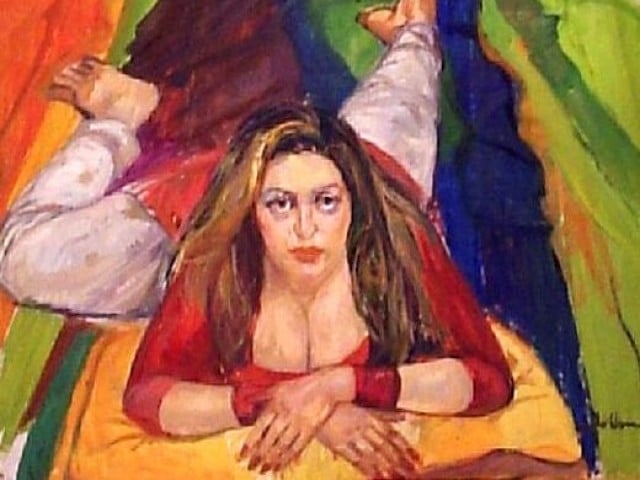
Oil painting of a prostitute from Lahore's Red Light District, by Iqbal Hussain

Prostitution in the Land of the Pure


Whenever I hear the word ‘prostitute’  the first image that comes to mind is an inappropriately dressed woman standing in filthy streets waiting for a client. The discussion on the issue how cruel the profession is to women – their empty, hungry stomachs forcing them to sell their bodies in order to buy bread for the family. But let’s think for a moment; what about all the men, the children, and the teenagers that engage in such acts?

In Pakistan, the topic of prostitution is taboo – one that is hardly ever discussed. It is difficult to describe or understand the scale of this corrupt profession.
The Society for the Protection of the Rights of the Child (SPARC) has said that hardly anyone has ever tried to challenge the problem of male prostitution thanks to the ‘strong social taboo’ it carries with it. This logically translates to the fact that the health department does not even have any data or records related to male prostitution, so they cannot tell us the exact statistics.
However, according to the National Commission for Child Welfare and Development, in 2001, it is thought that as many as 15,000 to 20,000 children were affected by commercial sexual exploitation. ‘Free floating’ prostitution resembles ‘the pick and choose scheme’ and is widespread in many major cities where under-aged children including hijras (transgenders) can be picked right off the street.
A child prostitute of 14 years can be easily bought with the meagre sum of three to five thousand rupees. Male child prostitutes – ranging from ages 15-25 – are thought to be cheaper than their female counterparts. Unlike females, male prostitutes are reluctant to reveal specific problems and details about their work because of social taboos.
Surveys show that children as young as eight-years-old work as male prostitutes. Since they have limited skills to rely on in order to support themselves, prostitution becomes the most practical and lucrative form of employment. According to data collected, children allege that police and army soldiers make up  a ‘significant portion of their clientèle’.
The sad thing is that even though many of these young boys are free to leave the profession whenever they want to, financial difficulties and lack of choices force them to continue. They, thus, grow up to be pimps themselves. A child prostitute is believed to earn up to Rs12,000 per month which is more than most jobs pay children.
Similar to prostitution is the practice of ‘bachabazi’ which exists in Pakistan mostly in the North West Frontier Province (NWFP). It is thought to refer to older men keeping young boys as their sexual partners with the former becoming responsible for the education, clothing and general care of the latter in return for ‘sexual favours.’
Through a study, the National Coalition of Child Rights and the United Nations International Children’s Emergency Fund (UNICEF) discovered that a third of the men living in NWFP were proud to be pedophiles. Another 11% thought there was nothing wrong with this practice.
The National Commission for Child Welfare and Development (NCCWD) interviewed 233 children in the country’s four provinces and found out that a shocking amount of 159 revealed that they had engaged in commercial sex. Out of the 159, 98 were boys who found business in public places such as hotels, restaurants, video shops, cinema halls and parks.
According to surveys, 95% of the teenage prostitutes in Islamabad, Rawalpindi and Lahore were sexually abused by their close relatives, friends and teachers before entering the business of prostitution. Contrary to common judgement of prostitutes normally being uneducated and poor, research has shown that 74% of them were university graduates.
Although one tends to associate prostitution only to women, men, teenagers and children are equal victims, suffering the cruel injustice of being sexually abused. Young children are pushed into this profession simply because they do not have enough money or the skills that come from a good education. Moreover, young, naïve people fall victim to the cruel and ruthless pimps who entrap them with promises of money and transform them into the very same monsters they are.
Prostitution, whether it is legal or not in various countries, is a form of discrimination against humanity. It is degrading, it spreads diseases, and encourages lazy labour. We must put a stop to it.