Showing posts with label Pakistan. Show all posts

Thursday, January 5, 2012

Sharia: Women's Rights and Rapes


YouTube:
Uploaded by YouCruising on Jan 5, 2012
In sharia compliant islamic countries sexual assault is a way of controlling muslim women.

Tuesday, December 20, 2011

Going To The Chapel and I'm Gonna Get Married


It’s time to criminalise forced marriage


Charlotte Rachael Proudman


The Independent
The number of forced marriages is rising every year in the UK. The Government’s Forced Marriage Unit alone dealt with 1735 cases in 2010. 70.9% of these involving families of Pakistani, Indian and Bengali background. 86% of victims were female and 35% were under 18. Of course, the Forced Marriage Unit’s figures do not reflect the full scale of the abuse, as many cases go unreported.
Forced marriage is an appalling and indefensible practice which is recognised in the UK as a form of violence against women and men, a serious abuse of human rights and, where a minor is involved, child abuse.  Yet forced marriage is not illegal in the UK.
Concern for victims of forced marriage led to the Forced Marriage (Civil Protection) Act 2007, which provides a specific civil remedy called a Forced Marriage Protection Order (FMPO).  FMPOs play an important role in protecting victims of a threatened or actual forced marriage from their families, although organisations working with victims of forced marriage report that breaches are common.   In May of this year the Home Affairs Select Committee recommended that the government make forcing someone to marry a crime.  In October the Prime Minister announced plans to do just that, and a public consultation on making forced marriage a specific criminal offence launched last week. I fully support the government’s plans.
Prior to practicing as a family law pupil at Coram Chambers, I undertook research into forced marriage at Cambridge University during 2010-2011.  I interviewed women from South Asian communities, several of whom were survivors of forced marriage.  Having repeatedly heard that victims of forced marriage do not want to criminalise perpetrators of forced marriage, often their families, and that making forced marriage a crime will deter victims from coming forward, I was surprised to find that all of the women I spoke to were strongly in favour of criminalisation. In fact they appealed to me to put forward their views and ensure their voices are heard amongst saturated political and media rhetoric, which appears to have falsely portrayed their views.
They argued that if forced marriage had been a criminal offence when they were forced to marry they would have used the law as a bargaining chip to negotiate with their parents.  They believed that a criminal penalty would act as a deterrent, and also argued that legislation would have a symbolic function in sending a message to perpetrators that forced marriage is socially unacceptable. All of the women I spoke to said they wanted recognition of their rights and of the wrong that had been inflicted on them, and demanded that bringing perpetrators to justice and protecting victims should be prioritised over concerns about demonising the communities which practice forced marriage.
Those in opposition to criminalisation have argued that the criminal aspects of forced marriage – for example abduction, assault and rape – are already covered by existing criminal offences.  Yet these offences do not tackle the control, persuasion, pressure, manipulation and threats that many women experience over time, and they do not offer justice to all – or even to many – victims of forced marriage.
One woman I spoke to, Sami*, was taken to Bangladesh at the age of 17 and subjected to emotional and psychological pressure over a number of weeks in order to force her to marry her cousin.  Sami was told that the marriage was a duty to her parents and to God, and was warned that she would be rejected by her family and by the South Asian community if she did not go ahead with the marriage. When this failed her mother pretended to be ill, whilst her father held a knife to his throat. This immense pressure eventually led Sami to capitulate and enter into a forced marriage.
Sami’s forced marriage would not be illegal under the existing criminal law.  Whereas annulment legislation in England and Wales and the Forced Marriage (Civil Protection) Act 2007 recognise psychological, financial and emotional coercion as forced marriage, criminal legislation does not.  This gap can only be remedied by introducing a specific criminal offence of forced marriage which encompasses a range of coercive behaviours.  Other countries have already done this.  For instance, the Norwegian Criminal Code defines forced marriage as involving “recourse to violence, deprivation of liberty, undue pressure or other unlawful behaviour, or through the threat of such behaviour”.
Criminalisation of forced marriage will make it easier to take action against perpetrators, rather than making use of a patchwork of laws that are not specifically designed to tackle forced marriage, and it may also challenge the attitudes of those who perceive coercion – whether emotional, physical, financial or otherwise – to be acceptable.
Alongside a specific criminal offence of forced marriage, more must be done to challenge the practice within communities and to support victims. Increased funding is needed for groups such as the Iranian and Kurdish Women’s Rights Organisation, which works with victims of forced marriage and campaigns for a tougher response by government and by statutory bodies such as schools.
Many women who are victims of forced marriage feel terribly let down by our Government. It’s time for the Government to stop abrogating its responsibility and to safeguard the rights of women by making forced marriage a specific criminal offence.
*not the interviewee’s real name
Charlotte’s book ‘Forced and Arranged Marriage Among South Asian Women in England and Wales: Critically Examining the Social & Legal Ramifications of Criminalisation’ is availlable on Amazon.co.uk

Monday, November 28, 2011

Sometimes I Feel Like A Motherless Child


Pakistani Hindus Take Refuge in India

A child peers over to see what her mother is reading
Tarun Vijay in New Delhi

Tarun Vijay visits a tent camp in New Delhi where Hindu refugees from Pakistan try and start a new life.

Pakistan doesn't send just terrorists like Ajmal Kasab. They send Hindus too -- forcing them to flee if they want to save their honour and their lives.
The common Hindu is a mute spectator to the changing times and the Abbotabad, Haqqani and ISI phenomenon.

He cannot comment on the political situation of his country. He cannot vote as freely as a common Muslim Pakistani. He is constitutionally directed to vote only for the Hindu candidates in their designated constituencies.
A country that might have taken birth in 1947, but the land belonged to his ancestors for centuries. He is as much the owner of the land of the 'pure' as any other religionist. But while the 'other' religionist is free to vote and shout for his rights and participate in the mainstream activities, he for just being a Hindu is asked to live in a cocoon.

Image: A child peers over to see what her mother is reading                                                    NEXT                                    


Is This A Religious Thing or Are Pakistani Men Just F *CK*D In The Head?

Pakistani Security Guard Sexually Assaults Two Sisters at School

The Nation KHANEWAL - Two minor British national Pakistani twin sisters, studying at the City Public School, were sexually assaulted by school security guard, while the school principal forcing their parents for compromise on the matter.
Father of the victims, Mian Junaid Khaliq and step-mother demanded Punjab Chief Minister Shahbaz Sharif, Inspector General of Police, RPO, DPO and DCO Rashid Mehmood to take legal action against the responsible and the school administration for supporting the offenders. 
According to details, 6-year-old twin sisters Safa and Marwah were the student of KG class in the City Public School Khanewal, during recess, the school lady-servant (Aaya), Shamin Bibi, told both the sisters that their some relatives were waiting for them in the guard’s room of the school. When both the sisters and lady-servant reached the guard room, security guard Aftab was sitting alone there. 
Shamim Bibi, after handing over the innocent girls to the security guard, slipped out of the room and the guard started sexual torturing both the sisters. They started crying for help and both succeeded to come out from grip of the guard and managed to reach their class teacher and principal but both officials reprehensibly ignored the incident. 
The victim sisters told their step-mother about the incident at home. Next day, school principal Rubana Fahim and some teacher forced the step-mother of the victim students to compromise on the matter and not to go to police, which would effect repute of the school. While, principal Rubana Fahim said she would terminate both security guard and lady-servant. 
Mother and father of Safa and Marwah have demanded the DPO Khanewal for registering a case against the responsible. Father Junaid Khaliq has told the media that he is very disappointed with the situation, because he believed that his daughters would get Islamic education and awareness about Islamic culture in the Pakistani school but now he is sending his daughters to the UK. He warned if legal action is not taken against the responsible, he will also involve the British High Commission in Pakistan in the case. 
Principal Rubana Fahim is avoiding the media to give her version, and refused to meet newsman in her office.

Sunday, November 27, 2011

My Big, Fat, Forced Marriage


Inside an arranged marriage
Sameem Ali was forced to wed at the age of 13, 
but later fled the marriage

27 Nov 2011

It was a small outward rebellion symbolising far greater inner opposition: on her wedding day, 18-year-old Sairah refused to wear the bridal red of Asian weddings, or be bedecked in traditional, heavy gold jewellery.

Instead, she wore pistachio green with a thin, delicate chain around her neck. “What are you doing?” her family demanded. But Sairah insisted. For four years, she had resisted this ceremony. But now she was in Pakistan, far from her home in Scotland, about to marry her cousin. This morning, as the mehndi – intricate henna designs – were applied to her hands, she had passed out. “I was so stressed,” she explains. “I knew within myself that I was not going to be his wife because I didn’t love him. He was not my husband in my heart. I went ahead thinking, what am I going to do?” The ceremony itself was like any Asian wedding. She smiles. “Except I kept my gob shut.”
Tomorrow, new legislation will come into force in Scotland to tackle the problem of forced marriages like Sairah’s. Those at risk will be able to take out a Forced Marriage Protection Order to prevent them being pressurised into an unwanted wedding, and there is also provision for annulling forced ceremonies. This brings Scotland into line with other parts of the UK but, crucially, the legislation goes a step further. Until now, there has been resistance to criminalising forced marriage, (though the Prime Minister, David Cameron, has recently called for the matter to be reconsidered), because Asian women, in particular, would be reluctant to use the law against their own families. In Scotland, having an FMPO taken out against you will not in itself be a criminal offence, but breaching it will be, with penalties including fines and up to two years imprisonment for the most serious cases.
“It’s a great compromise,” says Sameem Ali, who was 13 and living in Scotland when she was forced into marriage in Pakistan. Ali, now a Labour counsellor in Manchester, became a mother at 14. “Criminalising forced marriage completely would push it under the carpet and nobody would come forward,” she argues. “In 2005, female genital mutilation was criminalised. Not one case has come to court. The victims have gone underground and awareness on the subject has gone too. I am passionate about not making forced marriage a female genital mutilation scenario.”
Existing legislation is already used for serious criminal offences related to forced marriage, including kidnap, rape, and child abuse. Ali’s own brother was sentenced to four years after police intercepted a group carrying weapons, and a piece of paper with Ali’s address, when she fled her marriage.
The sensitivities around forced marriage are perhaps similar to those that once existed around domestic violence. The police were reluctant to interfere in marital disputes. That was family. A man’s private business with his wife. It took time for society to recognise that being married didn’t give you ownership of your partner. Now, it is recognising that parenthood doesn’t give you ownership of your child. Forced marriage is sometimes considered a religious issue but every major world religion, including Islam, strongly disapproves of the practice.
It is a cultural issue, connected to family traditions and notions of honour. But that, says John Fotheringham, an accredited specialist in child and family law who has been part of the Scottish Government’s consultative process on forced marriage, is irrelevant. “We don’t care if it’s cultural – it’s not on. This is Scotland and Scots law will apply.”
“Honour” is sometimes taken to extremes. Police are investigating whether Glaswegian Saif Rehman and his American wife Uzma Naurin, gunned down in Pakistan this month while attending a wedding, are the victims of honour killing after Uzma refused arranged marriage. Such cases are rare and care is usually taken to distinguish between forced and arranged marriage, where the parties may not know one another but give free consent to marry. But drawing a clear line can be difficult, argues Fotheringham. “The forced marriage where someone says marry this man or you will be killed, is very extreme. People don’t say that often. What they say is, marry this man or your mother will kill herself and your university funding will be cut off.”
More Here   (Requires Registration)

Saturday, November 26, 2011

Lest We Forget 26/11


Blood, bullets and beyond: bitter 26/11 lessons


IBN Live  Three years have passed since the horrific events of 26/11 held us hostage for 62 hours, from the night of November 26 to the morning of November 29, 2008. A significant element in those attacks was the visible engagement of Pakistan based Lashkar-e-Taiba (LeT) terrorists in a frontal gun battle with Indian security forces. Earlier terror attacks had generally involved simultaneous bomb blasts in crowded market places, religious sites and office complexes.
The intensity and meticulous planning that went into the Mumbai attacks were of an unprecedented nature. National Security Guard (NSG) commandos expressed surprise at the training level of the LeT terrorists and the quantity of weapons carried by them. The involvement of the LeT in terrorist activities inside India is a critical security concern for India.
The stated objective of the LeT is to wage violent jihad in India in order to establish an Islamic rule amongst India's Muslim population. It also aspires to form a Union of Muslim majority areas surrounding Pakistan through violent means. Towards achieving this goal, the countries that have been listed as enemies of the LeT are India, Israel and the United States. Besides the LeT, there exists the menace of homegrown terror outfits like the Indian Mujahideen (IM). However, unlike the LeT, the IM is not a well-knit organisation devoid of any clear hierarchical structure.
Succumbed
Despite this knowledge on the LeT's objectives much before 2008 vis- -vis India, Mumbai succumbed to its terror plan. Added to intelligence assessment failure on the LeT's terror plans was the fact that the Mumbai attacks were preceded by terror attacks on Jaipur, Ahmedabad, New Delhi and Assam that year, which should have alerted the security agencies on the possibility of future terror attacks on major Indian cities.
Significantly, the US State Department 'Country Reports on Terrorism 2008' identified India as one of the world's most terrorism-afflicted countries. Sadly, after a lull of three years, Mumbai has again fallen prey to terror attacks in July this year. Given this, the obvious question that comes to mind is: Why has Mumbai been a recurring target of terror attacks since 1993? There are three plausible answers to this question.
First, attacking Mumbai increases the credibility and visibility of the terror outfit concerned. By definition, terrorism is "the use of violence against civilians for political ends". Terrorists engage in "costly signaling" (violent attacks) in order to spread terror, sabotage the institutions of a state and establish their own deadly credibility to a target audience: their own recruit base, ideologues and terror financiers. Second, it exposes the inability and weaknesses of Indian security agencies. Third, attacking Mumbai, India's financial capital brings global attention on India as an unsafe place for investment and tourism.
Doubts
Recurring terror attacks inside India raises serious doubts about India's counter-terror mechanism. The common fear prevalent in India is the ability of terror outfits to repeatedly target Indian cities despite security measures being strengthened in recent years.
There is a deep-seated belief that the country lacks effective and well-trained counter-terror forces. In fact, counter-terrorism mechanisms in India suffer from more than just a lack of 'effective' counter-terror forces. There are existing structural problems that afflict the entire police force across states. For instance, in cities like Delhi and Mumbai today, most of the best trained police personnel are utilised for VIP security.
For instance, nearly 60 per cent of the 83,740 or more police personnel in Delhi are employed for securing VIPs and their movements. The living conditions of most police personnel are sub-optimal; they are made to work in conditions where even basic amenities are absent. Out of 76,613 Assistant Sub-Inspectors (ASIs) in Delhi, nearly 63,103 are yet to get housing promised to them.
Also, the ratio of police personnel at the level of constables in Delhi is much lower than the mid level ASIs, thereby coming in the way of a visible police presence on the ground. While special units to fight terror have been raised in cities like Mumbai, these have so far proved inadequate. What further affects the effectiveness of the police force in cities like Mumbai is that sub-inspectors and constables are over-stretched and do not have time to attend refresher courses to update their skills in terms of proficiency in the latest technology or concepts in counter terrorism.
Technology
For instance, the lack of expertise on the use of cyber space and technology by terrorist groups in India is another key area of concern. The emails sent by the IM after the terror attacks in Ahmedabad and Delhi in 2008 were through hacked wi-fi connections in Mumbai. Incidentally, the IM's top leader Abdul Subhan Qureshi is a highly trained computer specialist.
The use of satellite phones by the 10 LeT terrorist in the Mumbai attacks was visible. Cyber-terrorism could target critical infrastructure like financial sectors, telecommunications, banking and finance, gas and oil storage facilities and government operations within India.
Such attacks could undermine national security, erode confidence in government, and damage the economic system of a state. Malicious software is widely available and does not require special technical skills to disseminate and create terror. To deter this, law enforcement agencies in India would require expertise in cyber and other technologies if they are to keep pace with the terror outfits' growing prowess in using technology.
Lessons
Be that as it may, the Union government did take some measures to strengthen its counter-terrorism mechanism immediately after 26/11. First of all, learning a bitter lesson from the slow movement of the then elite NSG personnel to Mumbai to counter the 26/11 terrorists, a number of NSG regional hubs have been set up in Mumbai, Kolkata, Chennai and Hyderabad.
Also, India's coastal security has been beefed up by developing an integrated approach between the Indian Navy and the Indian coast guards to secure India's long coastline of 7, 517 km. This integration has been set up under the command of the Naval Chief to bring about effective coordination. The most significant institutional counter-terrorism measure was the setting up of the National Investigation Agency (NIA) in 2009.
The NIA is India's first federal agency to deal with cases pertaining to terrorism, investigating terror links, and linking up different intelligence agencies like the Research and Analysis Wing (RAW), the Intelligence Bureau (IB) and other state intelligence agencies.The integration of intelligence inputs is a much-needed change as the biggest state failure in India while fighting terror has been its inability to assess intelligence inputs.
This shortcoming has come in the way of providing clear guidelines to implementing bodies in order to prevent terror attacks from occurring on Indian soil. Counter-terror mechanisms like the intelligence agencies and security personnel have also been routinely plagued by lack of intelligence sharing, trust, inter-agency coordination and turf wars. While an important step in counter-terrorism, the NIA is not an appropriate agency for enabling such seamless intelligence flow, assessment as well as coordination as it is more a reactive than a preventive body. The NIA' s chief task is to investigate terror cases once the act has already been carried out.
Critical
The critical question that arises in this regard is: how has the US been successful in averting terror attacks on its soil since 9/11? The answer is not too far to seek. Immediately after 9/11, the Bush administration engaged in a massive reform of institutional mechanisms to avert and respond to future terror attacks on US soil.
A 'Department of Homeland Security' headed by a 'Director of Homeland Security' was set up with a massive staff of 170, 000, making it the second largest US federal body after the Department of Defense (DoD). The overall working of the department is guided by the policy document titled "National Strategy for Homeland Security" with a three words punch line: prevent, protect and respond. The main philosophy behind the Homeland Security Department is to not only prevent terror attacks but also enable a rapid response in case there is a terror attack.
The Department of Homeland Security also brings together different intelligence agencies like the Federal Bureau of Investigation (FBI) and the Central Intelligence Agency (CIA) to share intelligence. This has mitigated turf wars to a large extent as well as addressed the tendency of intelligence agencies not to share secret information. Integration of intelligence has enabled forming a holistic map of terror networks, financing and source.
Further on, the Department of Homeland Security also pools in several other organisations like the US Coast Guard, the US Customs Service, the Nuclear Incident Response Team, the Federal Computer Incident Response Team, the Animal and Plant Health Inspection Service, and many others, making information flows an inter-agency matter. This massive need for coordination has necessitated a change in US bureaucratic attitudes in order to tide over different cultures and histories of each department, and guard against the powerful incentive to protect one's turf. The end result is however an effective counter-terror mechanism.
Vulnerable
This kind of inter-agency coordination is sadly missing in India rendering Indian cities like Mumbai vulnerable to terror attacks. One can realistically imagine a scenario where a coordinated cyber or bio-terror attack will succeed in disrupting life in India given the absence of a coordinated cyber or public health response system to counter such attacks.
The need of the hour in India is to establish a Federal Counter-Terrorism Mechanism, which will integrate the various intelligence agencies, state police, customs, border security, cyber and public health departments to counter terror attacks. India should devise a counter-terrorism strategy which is well-coordinated and led by specialized units with superior intelligence-gathering and assessment skills. The government must immediately activate effective countermeasures including covert operations against terror networks based on sound intelligence and efficient bureaucratic coordination.
Visible policing is another critical component in fighting terrorism and must be conducted by personnel who are well trained, well paid and motivated enough to get the job done. Unless such a change occurs at the ground level, major Indian cities like Mumbai are likely to suffer from repeated terrorist attacks. At the same time, given that the terror group which targeted Mumbai on 26/11 was just one small cell of a larger terror network spread across South Asia, defeating the network would require the concentrated efforts of all countries in the region.
It is time a common counter-terror framework under the mechanism of South Asian Association for Regional Cooperation (SAARC) is also created.

Tuesday, November 22, 2011

Republican GOP Candidates Bash Pakistan


Pakistan amongst most violent, unstable nations

WASHINGTON: Republican presidential candidates have criticised Pakistan, calling it one of the most violent and unstable nations but remained sharply divided over whether the US should continue to provide aid to Islamabad.
While Texas governor vowed to cut down US aid to Pakistan to zero till it helped US meet its national security interests against terrorists, two other Republican candidates Jon Huntsman andNewt Gingrich argued in favour of more drone attacks against terrorists inside Pakistan.
Congresswoman Michele Bachmann, however, argued in favour of continued engagement with Pakistan given that it was a nuclear weapon state.
"Pakistan is a concern. That's the country that ought to keep everybody up at night. You have not (Pak) President (Asif Ali) Zardari in charge but (its Army Chief) General (Ashfaq Pervez) Kayani, over the military, which also is responsible for the ISI.
"You've got the youngest demographic of 160 million people in Pakistan. You've got a madrassa movement," Huntsman said.
"You've got over 100 nuclear weapons. You've got trouble on the border. You've got a nation-state that is a candidate for failure. I say it's a haven for bad behaviour, it's a haven for training the people who seek to do us harm," Huntsman said adding that he was in favour of expanding drone program which would serve US national interests.
Acknowledging that Pakistan has been "the epicentre of dealing with terrorism" Congresswoman Bachmann said that the country has training centres for terrorist outfits.
"They also are one of the most violent, unstable nations that there is," she said.
A member of the intelligence committee in the House of Representatives, she said 15 of the nuclear sites in Pakistan are available or are potentially penetrable by jihadists.
"Six attempts have already been made on nuclear sites. This is more than an existential threat," Bachmann said.
"We have to take this very seriously. The US has to be engaged. It is complicated. We have to recognise that the Chinese are doing everything that they can to be an influential party in Pakistan. We don't want to lose influence," she said.
"...A nation that lies, that does everything possibly that you could imagine wrong -- at the same time, they do share intelligence data with us regarding al-Qaida," she said.
"We need to demand more. The money that we are spending right now is primarily intelligence money to Pakistan. It is helping the US," Bachmann said thus arguing that it was not in the national security interest to snap ties with Pakistan.
"At this point I would continue that aid, but I do think that the Obama policy of keeping your fingers crossed is not working in Pakistan," she said.
However, Texas governor Rick Perry advocated against any aid to Pakistan.
"Until Pakistan clearly shows that they have America's best interests in mind, I would not send them one penny," he vowed.
But Bachmann still argued in favour of engaging Pakistan as the consequences otherwise would be very dangerous for the US.
"We have to recognise what's happening on the ground. There are nuclear weapons all across this nation, and potentially al-Qaida could get a hold of these weapons," she said.
Perry said that US needs to engage in India and Afghanistan.
"We've got Afghanistan and India working in concert right now to leverage Pakistan," he said.
"I think if we would create a trade zone in that part of the world, where you have all of those countries working together, that may be the answer to getting Pakistan to understand that they have to work with all of the countries in that region," the texas governor said.
Gingrich, the former Speaker of the House of Representatives, took a tough approach against Pakistan.
"You tell the Pakistanis: Help us, or get out of the way, but don't complain if we kill people you're not willing to go after on your territory where you have been protecting them," he said.

Rape: It's The White Girls Fault!

It's Because The White Girls Tend To Make Themselves Look Slutty ... The Pakistani Girls Don't Do That!


From YouTube:

Uploaded by EruditeConcepts on Nov 20, 2011
A Muslim gang of 'sexual predators' cruised city streets for girls as young as 12 - usually white - who were then plied with drink and drugs and raped or abused.
Up to 100 'vulnerable' girls may have been groomed, abused or supplied cocaine by married fathers Abid ­Saddique and Mohammed Liaqat, and their friends.

A court heard the pair used Liaqat's BMW saloon to trawl for victims, pulling up alongside girls outside shops or schools and chatting them up before a 'campaign of calls and texts' to groom them.

Unemployed Liaqat, of Sinfin, Derby, was convicted of rape, aiding and abetting rape, being involved with child pornography, two sexual assaults, four counts of sexual activity with a child, and affray.
Of the other defendants, Akshay Kumar, 38, Faisal Mehmood, 24, Mohamed Imran Rehman, 26, Ziafat Yasin, 31, and Graham Blackham, 26 - a convicted sex offender who was the only non-Asian member of the gang to face a judge - have already been jailed after being convicted of a string of sex or drug offences.


Liaqat's brother, Naweed, 33, and Farooq Amed, 28, pleaded guilty to perverting the course of justice and were both jailed for 18 months.


Convictions were achieved in relation to 15 of the 26 victims across the three trials.
Saddique and Liaqat will be sentenced at Nottingham Crown Court in January.
A Serious Case Review by Derby Safeguarding Children Board is due to be published about the case imminently.


One victim, who was raped in a car after being driven to a country lane by Liaqat and a second man, told how she was targeted aged 16 after telling the men she came from a broken home.
She said: 'They would take you out, buy you ice creams and take you out for a lovely nice meal. And there's part of you that thinks it's really exciting and there's part of you that thinks, "I have met this lovely nice man and he's taking me out for a really nice meal".

Saturday, November 19, 2011

Preach Terrorism or Die!

The militants shot the cleric dead inside the mosque.

NOWSHERA:  A mosque cleric was shot dead by militants in Nowshera District, after resisting their attempts to preach terrorism in his mosque Police said.
Obaidullah Ustad, imam of the Shaidu village mosque in Nowshera had earlier stopped militants from preaching “terrorist values” at the mosque. “It was because of this resistance that the militants returned later in the evening and shot him inside the mosque” District Police Officer (DPO)Muhammad Hussein said while speaking to The Express Tribune.
Obaidullah was severely injured and rushed to the hospital where he succumbed to his injuries hospital authorities said. Sources said that the militants wanted to have access to the mosque and use it as a base to find new recruits. The militants reportedly belonged to the Tehrik-e-Taliban Pakistan (TTP).
Nowshera and its surrounding area have been the hub of militant activities in the recent past. On October 28, a suicide bomber claimed the life of two police officers as he attempted to target Ajmir Shah, the SHO who had started a massive operation against militants in the area.

Pakistan: Where The Dead Have No Name


From YouTube:

From: dawndotcom  | Oct 21, 2011  | 2,020 views
This is the Edhi graveyard for unidentified bodies, situated in the desolate land between the Balochistan and Sindh border. Dawn.com speaks to the caretaker of the graveyard, Khair Mohammad.

Thursday, November 17, 2011

Pakistani Cricketer Worships Nude Vishnu

Sachin Tendulkar’s morphed nightmare with Poonam Pandey!
Uniform "Shopped" onto Nude Photo Show Pakistani Cricketer Worshipping Vishnu ...
For Pakistan...This Is Definitely NOT Cricket!
Mumbai: Sachin Tendulkar, the god of cricket in India, got the shock of his life when he learnt that some morphed nude pictures of him and sleaze queen Poonam Pandey were doing rounds on the internet.
Poonam Pandey, who became an overnight sensation post her claim to parade nude to celebrate Indian Cricket team’s World Cup victory, is mighty peeved with a nude morphed picture of hers in circulation on the web.
The controversial picture of hers that surfaced on the web shows her completely nude holding a framed picture of Lord Vishnu with cricketing legend Sachin Tendulkar’s face morphed on the God’s and a Pakistani cricketer bowing in front of the photo frame. What is more insulting is that the God is shown holding a bat, a ball, a helmet and the World Cup in his hands on website of modelzview.
Poonam took to Twitter to express her feelings on seeing the nude picture of hers. She retweeted the message of her fan with the link of the website that carried the picture in question.
She wrote, “TweetHrts & All my Fans round d World i do appreciate ur Love towards me but such edited pix really hurt me as for me Cricket is a RELIGION (sic).”

The attention starved girl also said that she was surprised to see such a picture of hers.

“Had Seen Few Pix Photoshoped oh RaOne ,Then also Singham ect. but never that someone would make a pic of mine like this . Crazy people lol (sic).”
She expressed unhappiness about mocking the game of cricket and the sport star, but did not regret the misuse of Lord Vishnu’s picture in the morphed image in her tweets. 
Recent Poonam Pandey Publicity Vid:


Waiting To Die In The Islamic Republic Of Pakistan

Crossrythms
Release International calls for Christian woman facing death sentence in Pakistan to be set free and for blasphemy laws to be repealed
It's a year since illiterate farm labourer Asia Bibi became the first woman in Pakistan to be sentenced to death under the country's notorious blasphemy laws. Since then, Asia has been confined to a tiny cell near Lahore, not knowing what will claim her life - the noose, or the militants who have threatened to kill her.

One cleric has offered a reward of 500,000 rupees - about £4,000 - for the person who puts her to death. Extremists have threatened to blow her up in prison, and her husband and children have been forced to go into hiding. Asia is in her mid-40s.

'Pakistan must set Asia Bibi free and protect her life from vigilantes,' says Andy Dipper, the CEO of Release International, a ministry to the persecuted church. 'And Pakistan must repeal this terrible law that has been used like a weapon to target Christians and other innocent people.'

Asia Bibi is a victim of Pakistan's blasphemy code, which was revived to implement sharia law in the Islamic republic. The accusation of blasphemy alone has been used to settle scores and to take out commercial rivals, imprisoning them or making them prey to vigilantes.

Politicians who oppose the laws have been murdered. The governor of Punjab, Salman Taseer, was killed in January by his own bodyguard for calling for Asia's release and for the repeal of the blasphemy laws. And within two months the minister of religious minorities, Shahbaz Bhatti, a Christian, was assassinated for the same reason.

Asia Bibi found herself accused of blasphemy after a dispute with her Muslim co-workers. Some of the women had been putting her under pressure to renounce her Christian faith and accept Islam. Asia responded by sharing her faith in Christ.

Asia was then beaten and threatened by a mob before being taken into protective custody. On June 14 2009 she was accused of uttering blasphemies against the prophet Mohammed - a charge Asia has always denied - and in November 2010 she was sentenced to death.

She has appealed against execution. If the High Court upholds the death sentence Asia Bibi will be the first woman in Pakistan to be legally killed for blasphemy.

'In previous cases, the death sentence has not been carried out,' said Andy Dipper of Release International, 'but this could well mean a life sentence for Asia in appalling conditions.' She is currently held in isolation in a secure cell.

Release International has called for an end to the blasphemy laws and this year presented a 51,000-name petition to the Pakistan High Commissioner in London calling for religious freedom. Mr Wajid Shamsul Hasan said, 'We share your concerns, and we will do our utmost in the best possible way to provide security for the minorities and to alleviate their sufferings.'

'Please pray for Asia Bibi,' said Andy Dipper. 'Pray that God will comfort and strengthen her. And pray that Pakistan will put an end to these deeply unjust blasphemy laws that have been used to target Christians and others in acts of revenge.'

Release partners VOM-USA have created an online petition to free Asia Bibi. Since its launch in August, it has been signed by more than 300,000 people. It can be signed online at www.CallForMercy.com

Tuesday, November 15, 2011

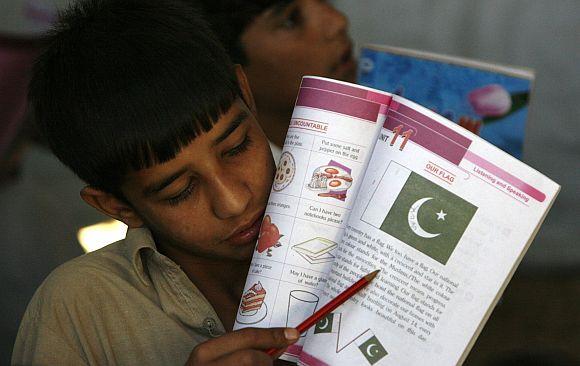
Pakistan: Reading, Writing and Inciting ... Hatred


How Pakistan Pumps in Hatred Through Textbooks


The findings of a recent US report indicate how deeply ingrained hard-line Islam is in Pakistan and help explain why militancy is often supported, tolerated or excused in the country, writes noted Pakistani journalist Amir Mir.

A recent study report by the United States Commission on International Religious Freedom has researched the Pakistani school textbooks to discover how the ruling regimes attempt to construct nationhood in the young minds and how textbooks are misused as an instrument of ruling paradigms to develop a particular anti-Hindu and anti-India mind set.
Funded by the USCIRF, the 139-page study report was prepared by the International Center for Religion and Diplomacy in partnership with a Pakistani think tank, the Sustainable Development Policy Institute.
The report was released in Washington on November 9.
After poring through more than 100 textbooks from grades 1 to 10 across all four provinces; visiting 37 public schools and interviewing 277 students and teachers; visiting 19 madrassas and interviewing 226 students and teachers, the US commission members discovered that there is religious bias in Pakistani textbooks which teaches bigotry against the minority communities of the country.
The USCIRF study report shows how education can be distorted to construct a particular kind of national chauvinism and a mind set and how ruling regimes intervene in education to promote certain ideologies that suits their own interests.

Monday, November 14, 2011

Progressive Change To Electoral Rules In Islamic Republic of Pakistan

Registered Eunuchs Eligible to Vote in General Elections
Pakistan Today


All registered eunuchs will be eligible to cast votes as citizens of Pakistan in general elections, as their names have already been added to the electoral rolls, a National Database and Registration Authority (NADRA) spokesman said on Monday. He said the authority ensured the registration of all citizens irrespective of their caste, creed or gender. He said NADRA was the first organisation in Pakistan that was providing job opportunities to the third gender at its regional offices in order to engage them as productive citizens of society. He said NADRA issued Computerised National Identity Cards (CNIC) to eunuchs in accordance with the instructions of the Supreme Court, and the authority was also extending registration facilities to the third gender at its mobile registration vans (MRVs) to facilitate eunuchs in remote areas. Their registration was carried out without any medical proof of their given particulars and details at the time of registration, he added. He said according to Supreme Court instructions, the eunuchs could choose to have “male transgender”, “female transgender” or “Khinsa-e-Mushkil” written on their CNICs. He said after the registration of the third gender as eunuchs, their rights were more protected and it would pave the way for more job opportunities for them in the public and private sector.

Saturday, November 12, 2011

Pakistan's Shame: Bestiality


From YouTube:
Uploaded by GroundZeroMosque on Nov 12, 2011

In 2010 the Islamic Republic of Pakistan was outraged when Youtube atheists decided to do a Draw Muhammad Day that they blocked Youtube and Facebook and created an international incident.

The Youtube community pushed for Draw Muhammad Day in support of cartoonist Molly Norris, who had to go into hiding after the FBI had discovered terrorist death threats against her by Islamists nuts. Molly decided to create Draw Muhammad Day after the death threats against South Park creators and the censorship by Comedy Central of any mention or depiction of Muhammad. Her premise for the creating Draw Muhammad Day was if everyone drew Muhammad then crazy Islamic terrorists could not kill everyone. She did it for freedom of speech and freedom of expression.

Well Pakistan did not like the idea and made a big stir by banning Youtube and Facebook....not a very smart move, because you cannot stuff the genie back into the bottle once it has been let out.

One things that is odd is that India's neighbor Pakistan's prudish outrage back fired and made more people draw Mohamed. Not only that but many people started to look closely at the 2nd largest Islamic country and noticed something very strange. For such a strict Islam practicing country...they sure love their animal and goat sex, not only that but boy sex, gay sex, and many other types of sex. It appears that a repressive Islamic society fuels strange sexual desires.

I wanted to thank those atheists and others who stood by Molly like Pat condell thunderf00t philhellenes dprjones mostly UK english people and not edl types. They were answering those few Muslims who were threatening people.

Double Crossers ... Pakistan

Secret Pakistan: Double Cross

In May this year, US Special Forces shot and killed Osama Bin Laden in Pakistan. Publicly Pakistan is one of America's closest allies - yet every step of the operation was kept secret from it.
Filmed largely in Pakistan and Afghanistan, this two-part documentary series explores how a supposed ally stands accused by top CIA officers and Western diplomats of causing the deaths of thousands of coalition soldiers in Afghanistan. It is a charge denied by Pakistan's military establishment, but the documentary makers meet serving Taliban commanders who describe the support they get from Pakistan in terms of weapons, training and a place to hide.


Part 1/6


Part 2/6


Part 3/6


Part 4/6


Part 5/6


Part 6/6

Thursday, November 10, 2011

Pakistani Schoolbooks Breed Hatred for Jews, Christians, Hindus and Others


Dislike of Christians is found in religious textbooks where Islam is described in opposition to Judaism and Christianity as creeds that rejected the pure message of Islam. 

The US Commission on International Religious Freedom has researched Pakistani school textbooks to discover that there is religious bias in them denigrating the minority communities of the country. After poring through more than 100 textbooks from grades 1 to 10 across all four provinces; visiting 37 public schools and interviewing 277 students and teachers; visiting 19 madrassas and interviewing 226 students and teachers, the commission members have come to the conclusion that “teaching discrimination increases the likelihood that violent religious extremism in Pakistan will continue to grow”.
It is admitted by all Pakistanis that their society is steeped in extremist passions, some of them excited by unjust legislations like the blasphemy laws. Entire communities, such as the lawyers at the lower and high courts, have begun to take direct action on the streets to implement their extremist agenda, to say nothing of the Taliban who burn schools in fulfilment of their own vision of the perfect Islamic state. As a shocking demonstration of this trend, most people in Pakistan think that Pakistan is not following sharia, agreeing with the madrassa network that the constitutional amendment that set up the Federal Shariat Court is not sharia at all.
Textbooks have always been biased. Dislike of Christians is found in religious textbooks where Islam is described in opposition to Judaism and Christianity as creeds that rejected the pure message of Islam. The Hindus of Pakistan get the double whammy. History in our textbooks, which begins with the advent of the Arab warriors in Sindh against local Hindu rulers, and ends with the Pakistan Movement as a refusal of the Muslims of India to live together with “an unjust and hostile” Hindu community, always shows them in a bad light.
According to the commission’s report, “Hindus are repeatedly described as extremists and eternal enemies of Islam whose culture and society is based on injustice and cruelty, while Islam delivers a message of peace and brotherhood, concepts portrayed as alien to the Hindu”. This kind of bias should be excised, but the evil is constantly confirmed by inexpert analyses of contemporary India as a Hindu-majority neighbour that is against the very existence of Pakistan. Anydramatisation of events in Indian-administered Kashmir on TV will also attempt an ideological definition of Hinduism as an evil religion. More ominously, every time the home-grown Taliban kill innocent Pakistanis, police chiefs appear on TV to say that India — in tandem with Israel and the US — has done the deed. After the Babri Mosque incident in India, Hindu temples were burnt in Pakistan.
These facts go beyond the textbook to target communities against whom the school is not supposed to teach. Hindus in Sindh are becoming victims of inhuman treatment as religiously intense organisations become strong in the rural areas of the province. The Christians of Punjab are also being collectively punished on trumped up charges of blasphemy and desecration of the Holy Quran. The textbooks reflect this mindset. The report by the US commission quotes from a Grade 4 book in Punjab: “Anti-Islamic forces are always trying to finish the Islamic domination of the world. This can cause danger for the very existence of Islam. Today, the defence of Pakistan and Islam is very much in need’. A biased teacher may report Christian pupils for blasphemy, as has happened in the past, knowing full well that it takes up to nine years to get off the hook for a blasphemy accusation, given the virulently prejudiced lawyers’ community.
Pakistan will reject the US commission’s report as per a routine that has given our officials a lot of practice in hiding the truth. Things are actually much worse in a country where TV programmes show youths voting in favour of extremist passions under the rubric of ‘ghairat’ and politicians hope to garner votes by favouring the Taliban and their worldview while rejecting any action against religious terrorism by saying ‘it is not Pakistan’s war’. Some years ago, a professor in Islamabad revealed the bias of prescribed textbooks. Today, society has far surpassed the textbook and lives a life of extremism and hatred of minority communities.

Sunday, November 6, 2011

Pak Does U-Turn and Drops Jamaat-ud-Dawah From Their Terrorist List

Islamabad: The Jamaat-ud-Dawah, a front organisation for LeT which carried out the 2008 Mumbai attacks, is not included in a new list of 31 banned extremist and terrorist groups released by Pakistan's Interior Ministry.

The Interior Ministry released the list of banned organisations on Saturday as part of efforts to bar such groups from collecting the hides of animals sacrificed during the Eid-ul-Azha festival. Hundreds of hides collected every year by members of the groups are sold to raise funds.
Though the Lashkar-e-Taiba was included in the new list, the JuD was not on it.
CNN-IBN
In the wake of the Mumbai attacks that killed 166 people, the UN Security Council had declared the JuD a front for the LeT.
After the Mumbai attacks, Pakistani leaders like Interior Minister Rehman Malik insisted that the JuD had been banned.
However, during a hearing in the Lahore High Court in 2009, a senior law officer admitted that no notification had been issued to ban the JuD.
The new list of banned groups includes Jaish-e-Mohammed and its front organisation Khuddam-ul-Islam, Sipah-e-Sahaba Pakistan and its front organisation Millat-e-Islamia Pakistan, al-Qaeda, Tehrik-e-Taliban Pakistan, Lashkar-e-Jhangvi, Sipah-e-Muhammad Pakistan, Tehreek-e-Jaafria Pakistan, Tehrik-e-Nifaz-e-Shariah Muhammadi and Hizb-ut-Tahrir.